
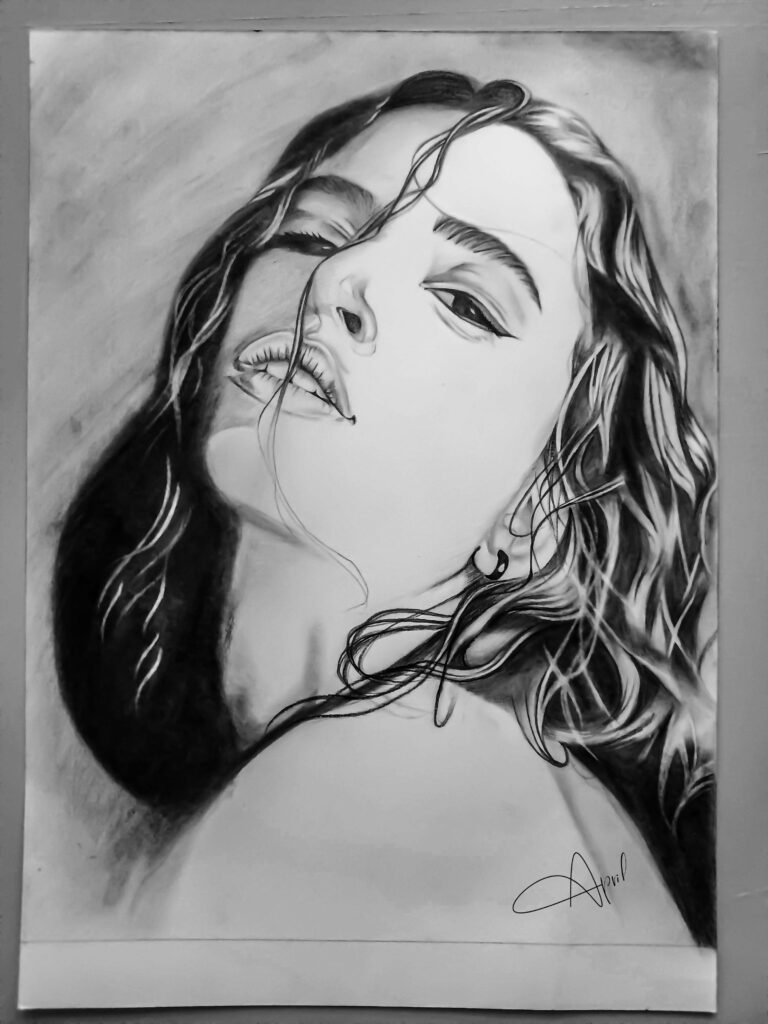
When commissioning a portrait, one of the most exciting aspects is deciding on the medium. While painting offers color, a drawing—whether rendered in graphite or charcoal—offers a timeless, powerful exploration of form, light, and shadow.
As an artist specializing in the monochromatic realm, I often guide clients through the subtle yet significant differences between graphite (what many refer to as “pencil”) and charcoal for their custom pencil portrait or custom drawing. Choosing the right medium is crucial, as it fundamentally affects the texture, mood, and detail of the final artwork.
This article will outline the essential differences between the two, helping you select the perfect one for your treasured piece.
I. Graphite: The Precision of the Pencil
Graphite is the classic, clean, and highly controlled medium used in most traditional custom pencil portraits. It is what people typically envision when they think of a pencil drawing.
What is Graphite?
Graphite is a crystalline form of carbon. Art pencils consist of a mixture of powdered graphite and clay. The ratio of these two components determines the hardness or softness of the pencil, which is indicated by a numbering system (e.g., $9H$ to $9B$).
- Hard Pencils (H series): Contain more clay, resulting in lighter, finer lines. Ideal for preliminary sketches and minute detail.
- Soft Pencils (B series): Contain more graphite, resulting in darker, richer tones and smooth coverage. Ideal for deep shadows.
The Look and Feel of a Graphite Portrait
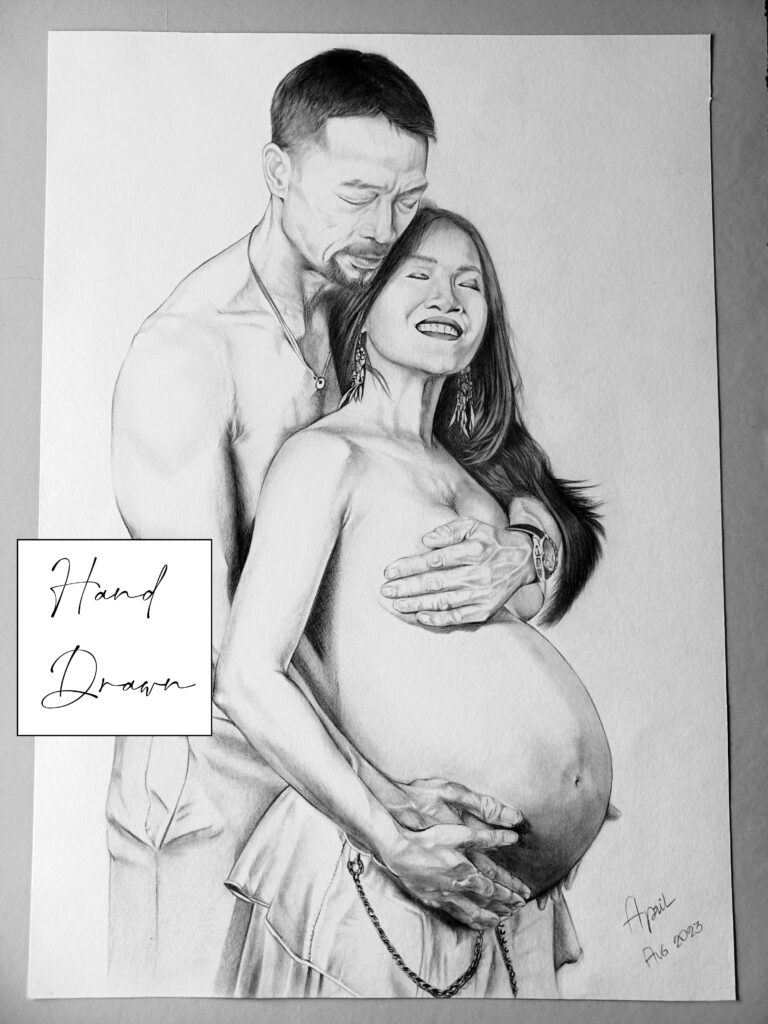
A graphite portrait is characterized by its precision and shimmering quality.
- Detail and Precision: Graphite is unrivaled for achieving photo-realistic detail. The sharp points of hard pencils allow for the rendering of individual hairs, fine wrinkles, fabric textures, and the delicate catchlights in the eyes. If high-fidelity realism is your priority for your custom drawing, graphite is the medium of choice.
- Shine and Sheen: Graphite naturally reflects light, giving the finished portrait a subtle sheen. This reflective quality is part of its charm, but it can make the drawing difficult to view clearly under direct light (a factor to consider when framing).
- Tone: The deepest tones achievable with graphite are a rich, silvery grey. It is difficult to achieve a true, matte black with graphite alone.
The Ideal Subject for Graphite
Graphite is perfect for clients who value:
- Photo-realism and accuracy.
- Portraits of young children, where a clean, delicate rendering is desirable.
- Small-scale portraits (A5, A4), where the medium’s inherent precision maximizes detail in a limited space.
II. Charcoal: The Power of Depth and Drama
Charcoal is an ancient medium, offering a completely different aesthetic experience. It is instantly recognizable for its deep, intense black tones and rich, organic texture.
What is Charcoal?
Charcoal is essentially burned organic material (usually willow or vine wood) or a mix of compressed carbon dust. It comes in various forms:
- Vine/Willow Charcoal: Very soft, light, and easily smudged. Ideal for creating soft tonal areas and quick blocking of shapes.
- Compressed Charcoal: Charcoal powder mixed with a binder. This is the source of charcoal’s intense blackness, available in stick or pencil form.
The Look and Feel of a Charcoal Portrait
A charcoal portrait is dramatic, atmospheric, and profoundly expressive.
- Depth and Contrast: The most significant advantage of charcoal is its ability to produce a true, matte black. This allows for incredible contrast, making highlights appear brighter and shadows deeper, resulting in a highly dramatic and three-dimensional effect.
- Texture and Softness: Charcoal naturally creates a softer, less precise line than graphite. It is best used to render subtle shifts in tone and texture, giving the skin or fur a beautiful, velvet-like quality. It is inherently a more expressive and looser medium.
- Matte Finish: Unlike graphite, charcoal absorbs light, resulting in a deep, non-reflective matte finish that enhances its darkness and is easy to view under any lighting condition.
The Ideal Subject for Charcoal
Charcoal is perfect for clients seeking:
- Dramatic, emotional portraits with deep contrast and atmosphere.
- Pet portraits, particularly animals with dark fur, where the rich blackness adds realism and texture.
- Large-scale portraits (A3, A2), where the medium’s broad coverage capability excels at covering a large area while maintaining visual impact.
III. Key Technical Differences: Graphite vs. Charcoal
Understanding the technical distinction between these two media is essential when placing your commissioning portrait order.
The Fundamental Difference: The Darkest Tone
| Feature | Graphite (Custom Pencil Portrait) | Charcoal (Custom Drawing) |
| Darkest Tone | Silvery-Grey (Reflective) | True Matte Black (Non-Reflective) |
| Erasability | Difficult to completely erase deep tones; leaves a slight shine. | Highly erasable; lifelike highlights are easily ‘lifted’ out. |
| Smudging | Minimal; takes effort to blend. | High; blends easily for soft transitions. |
| Detail | Exceptional; capable of rendering minute, fine lines. | Good for implied detail; more focused on general form and mass. |
| Fixation | Requires light fixative spray, often optional for small pieces. | Mandatory fixative spray to prevent smudging and preserve the artwork. |
A Note on the Custom Pencil Portrait Terminology
When you hear the term “custom pencil portrait,” it almost always refers to graphite. While charcoal sometimes comes in pencil form, graphite is the traditional “pencil” medium due to its precise nature. If your primary goal is photorealistic detail and a clean aesthetic, you are looking for a portrait rendered in fine graphite.
However, if you are looking for a custom drawing with a powerful, dramatic, high-contrast effect, charcoal is the appropriate medium, even though it requires a different technique and handling.
IV. Deciding on Your Medium
Before you finalize your order, ask yourself these questions:
- What is the lighting like in the reference photo? If the photo has intense shadows and highlights (high contrast), charcoal will amplify this drama beautifully. If the photo is evenly lit, graphite will render the subtle gradients cleanly.
- What is the desired mood? Do you want a clean, bright, delicate feel (Graphite), or a deep, atmospheric, and emotive feel (Charcoal)?
- How large is the piece? For the largest sizes (A2), charcoal is often the most impactful choice due to its capacity for deep contrast and broad strokes. For the smallest sizes (A5, A4), graphite’s precision is essential.
Whichever you choose for your commissioning portrait, both graphite and charcoal produce stunning, handcrafted pieces of art. The choice is simply about personal taste and the desired emotional impact of the finished drawing.
Unsure which medium is right for your unique photo?
Next Step: I would be happy to look at your reference photo candidates and recommend whether graphite or charcoal would best suit your specific image and desired scale. Would you like to proceed with that?